2.2.09

Living Art


Specimen of Secrecy About Marvelous Discoveries by EDUARDO KAC

"Specimen of Secrecy about Marvelous Discoveries" is a series of works comprised of what Kac calls "biotopes", that is, living pieces that change during the exhibition in response to internal metabolism and environmental conditions. Each of Kac's biotopes is literally a self-sustaining ecology comprised of thousands of very small living beings in a medium of earth, water, and other materials. The artist orchestrates the metabolism of these organisms in order to produce his constantly-evolving living works.
Odyssey

Theorem

The biotopes are a discrete ecology because within their world the microorganisms interact with and support each other (that is, the activities of one organism enable another to grow, and vice-versa). However, they are not entirely secluded from the outside world : the aerobic organisms within the biotope absorb oxygen from outside (while the anaerobic ones comfortably migrate to regions where air cannot reach). A complex set of relationships emerge as the work unfolds, bringing together the internal dialogical interactions among the microorganisms in the biotope and the interaction of the biotope as a discrete unit with the external world. The biotope is affected by several factors, including the very presence of viewers, which can increase the temperature in the room (warm bodies) and release other microorganisms in the air (breathing, sneezing).

The biotope is what Kac calls a "nomad ecology", that is, an ecological system that interacts with its surroundings as it travels around the world. Every time a biotope migrates from one location to another, the very act of transporting it causes an unpredictable redistribution of the microorganisms inside it (due to the constant physical agitation inherent in the course of a trip). Once in place, the biotope self-regulates with internal migrations, metabolic exchanges, and material settling.

Each of Kac’s “biotopes” has a cycle, which starts when the artist produces the self-contained world by integrating microorganisms and nutrient-rich media. In the next step, Kac controls the amount of energy the microorganisms receive in order to keep some of them active and others in suspended animation. This results in what the viewer may momentarily perceive as a still image. However, even if the image seems "still" the work is constantly evolving and is never physically the same. Only time lapse video can reveal the transformation undergone by a given biotope in the course of its slow change and evolution. Once an exhibition begins, in the third phase of the cycle the artist allows the microorganisms in suspended animation to become active again. The work becomes progressively different, changing every day, every week, every month. This process continuously transforms the image and may, depending of factors such as lighting conditions and exhibition length, result in its effacement — until the cycle begins again.

To find out more about Kac and his projects, click here.

28.1.09

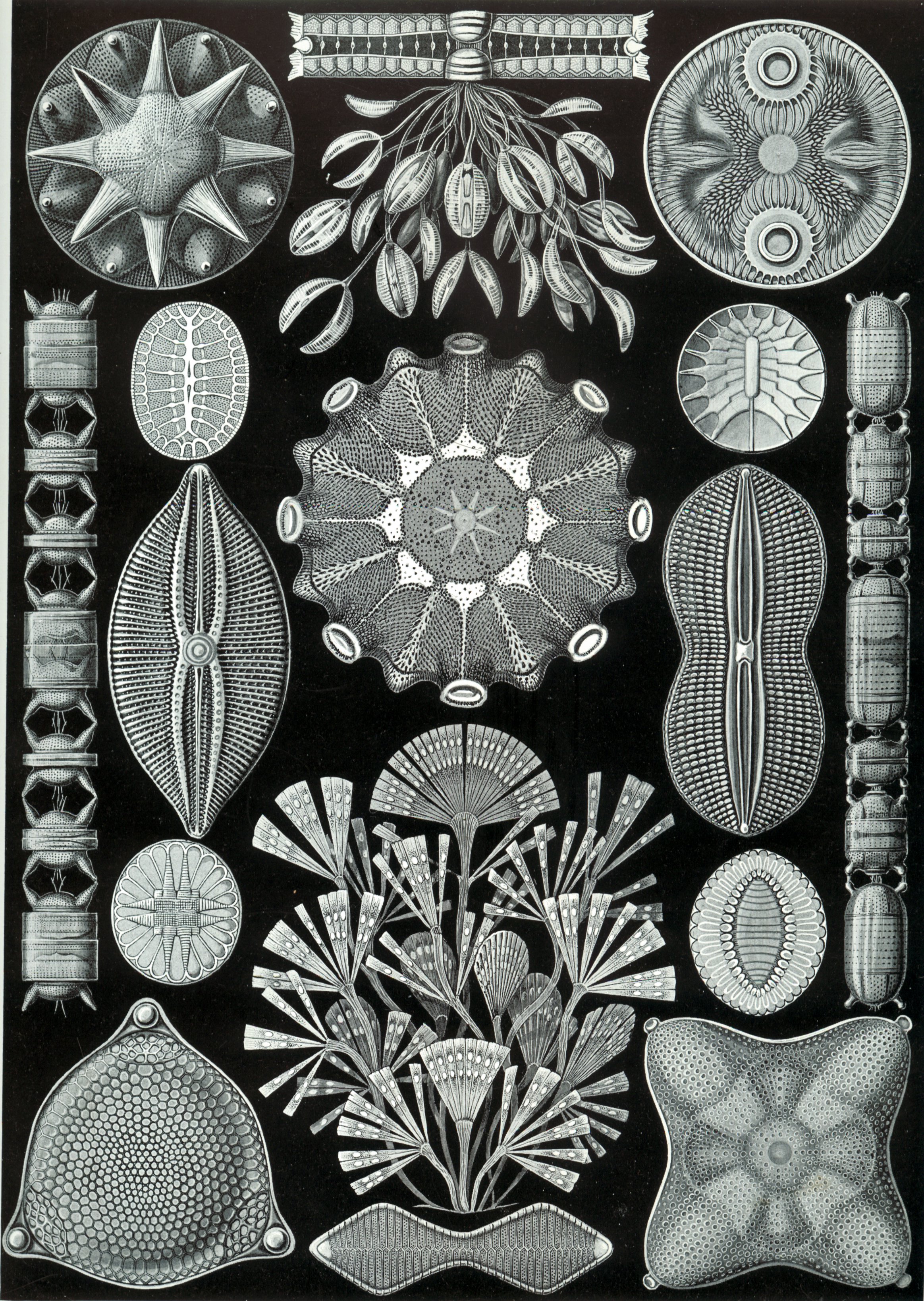
Interesting facts about Diatom

The 84th plate from Ernst Haeckel's Kunstformen der Natur (1904), depicting diatoms (Bacillariophyceae) http://commons.wikimedia.org/wiki/File:Haeckel_Diatomea.jpg

  • Diatom shell is made of Silica, the primary constituent of glass. (Silicon is in human connective tissues, bones, teeth, skin, eyes, glands and organs. It is a major constituent of collagen which helps keep our skin elastic, and it helps calcium in maintaining bone strength.)
  • Diatoms are a major group of eukaryotic algae, and are one of the most common types of phytoplankton. Most diatoms are unicellular, although they can exist as colonies in the shape of filaments or ribbons (e.g. Fragillaria), fans (Meridion), zigzags (Tabellaria), or stellate colonies (Asterionella).
  • When nutrient and light conditions are right, all diatoms are able to bloom - reproduce very quickly into huge numbers. They do this through vegetative or asexual reproduction. http://www.mbari.org/staff/conn/botany/phytoplankton/phytoplankton_diatoms.htm
  • Diatoms are primary producers, carrying out photosynthesis using a large proportion of a the pigment fucoxanthin. Fucoxanthin is contained in one or several round or star-shaped chromatophores, where photosynthesis takes place.
  • Diatoms come in two flavors: the round Centrales, and long or pen-shaped Pennales. http://www.mbari.org/staff/conn/botany/diatoms/john/basics/descript.htm
  • Diatoms account for 23% of the primary productivity of the world. That means that of all the photosynthesis going on at any one time, almost one-quarter of it is happening inside a diatom.
  • As primary producers, diatoms play a key role in marine food webs. They are an important food item for a larger class of animal plankton (zooplankton) such as copepods, as well as for all kinds of filter and suspension feeders from worms to anemones to mollusks like clams and mussels. http://www.mbari.org/staff/conn/botany/diatoms/john/basics/eco.htm
  • A diatom must live, on the average, at or above the critical depth, where sunlight is sufficient for photosynthesis. Natural selection has tuned all these factors to let diatoms live above that special depth. http://www.mbari.org/staff/conn/botany/diatoms/john/special/position.htm
  • Diatoms can be found in both fresh water and marine environments. Generally, diatoms inhabit most bodies of water in all parts of the world (if provided with sufficient amounts of nutrients). http://www.mbari.org/staff/conn/botany/diatoms/jennifer/introa.htm

Domain: Eukaryota
Kingdom: Chromalveolata
Phylum: Heterokontophyta
Class: Bacillariophyceae
Order: Centrales & Pennales


Diatom Quick Facts:

Cell size: 20-200 m m

Cell wall: SiO 2 or glass frustule

Chloroplasts: many/cell, 3-5 thylakoid membranes/stack

Photo-pigments: chlorophyll a & c, carotenoids

Reproduction: most often simple cell division, sexual reproduction

Ecological roles: produce deposits (diatomaceous earth), toxic blooms

Common genera: Chaetoceros, Pseudonitzschia, Skeletonema


.

23.1.09

20.1.09

New species found in South Australia


sources: BBC News Asia-Pacific

Australian scientists have just released data and images from a project investigating undersea life near Tasmania. Among the previously unknown creatures discovered was this species of Ophiacantha brittlestar. Images courtesy of CSIRO.

14.12.08

esteostudio - synthetic osteogenesis


Hybridization in biological approach integrates and generates new species that hardly to be categorized in Darwinism. Breakthrough in synthetic DNA in laboratory of Synthetic Genomics that leads by Craig Venter has created opportunity for future generation to basically create new species out of scratch. It means we are coming to an end of Darwinian Age and we are no longer limited to what "God" has "created" (if there is God).


Esteostudio (Skeletal Structural Design Laboratory) takes skeleton and bone structure design in an architectural context. By taking human and other organisms as precedent studies, skeletons and bones are being treated as structural material in both architectural and biological designs to create new possibilities. Biomimicry approach is being treated as a basic for understanding what is the best that nature has to offer. There is no clear boundary between future human and object, nature and artificial, organic and non-organic when comes to designing. With advancement in genetic, nano-technology, synthetic biology, semi-living materials and plasmatic design, designers and architects could take skeletal design as the principle to define the forms and functions of semi-living products. By breaking down the biomimicking process allows us to understand limitations in this material. However, the limitation also meant to be challenged. What nature has created is the harmony in design. Therefore both top-down and bottom-up design methodologies are being tested and executed along with the design process, while the nature rules is playing its part as the guidance for design constrains as well as ethical issues.

Homo-chiroptera


1.12.08

The end of the Darwinian interlude?

After Rachel Armstrong's Systems Architecture lecture, I looked into biotechnology more deeply and what got me excited in the past few weeks were:

1. What is going in J. Craig Venter Institute, which started with four basic chemicals that form an DNA and the first synthetic bacterial genome "born" in the laboratory this year.

2. Darwin v.s. Venter; the juxtaposition which Darwinian Theory shows that human wasn't made by God and Venter who is aclaimed playing the role of "God" by creating new life form.

3. Bottom up design method where molecular design in nano-scale defines the possible or unknown outcomes.

4. Success of Craig Venter may turn into what Freeman Dyson argued as "the end of the Darwinian interlude" (www.edge.org)

5. Works shown in Design and the Elastic Mind in MoMA New York ended in May even though I missed it but the online exhibition is available.

6. Development of DNA design software that allows anyone to design new species out of scratch, i.e. Gene Designer Software at https://www.dna20.com

7. With genomic technology, new life forms that could be created out of GenBank's database that contained over 65 billion nucleotide bases in more than 61 million sequences (2006).